
How to Choose the Right Air Duct Cleaning Company in Oceanside
The right Oceanside duct cleaning company is the one that can name its equipment before it names its price. Contractor-grade negative-air machines running at 1,500 to 2,000 CFM create the suction that actually pulls debris out of your system, while a modified shop vac simply moves dust around inside your ducts. If you’d rather skip the research and just get an honest assessment, call (855) 382-4811.
We pulled a return-air grille off a house in Fire Mountain last month and found a layer of construction debris from a 2016 remodel still sitting in the trunk line. The previous owner had paid for a cleaning three years ago. That’s not a rare story in Oceanside, where coastal humidity bakes dust into a paste that cheap equipment can’t dislodge. The problem isn’t always the crew. It’s the machine they’re dragging up the driveway.
Key Takeaways
- Ask the company to name their negative-air machine’s make, model, and CFM rating before booking anything.
- A contractor-grade system should move at least 1,500 to 2,000 CFM to create true negative pressure in a residential duct system.
- NADCA membership or ACR certification verifies training standards, not equipment capability. You need both.
- Red flags in Oceanside include per-vent pricing, quotes given sight-unseen, and subcontracting to uncredentialed crews.
- A legitimate post-service report should include before/after photos, components serviced, deficiencies found, and follow-up recommendations.
The One Question That Separates Real Duct Cleaners from Truck-Chasers
Ask them to name the make and model of their negative-air machine and state its CFM rating. Most companies you call in Oceanside can’t answer that question. They’ll tell you about their five-star reviews or their introductory price. They won’t know what CFM stands for.
CFM, or cubic feet per minute, measures how much air a machine moves. It’s the single most important number in duct cleaning because it determines whether the system creates negative pressure. Negative pressure is what holds dust, debris, and allergens inside the ductwork while the cleaning happens. Without adequate CFM, the machine doesn’t contain the particulates. It suspends them. Then they drift back into the house through your supply registers and settle on furniture, bedding, and floors.
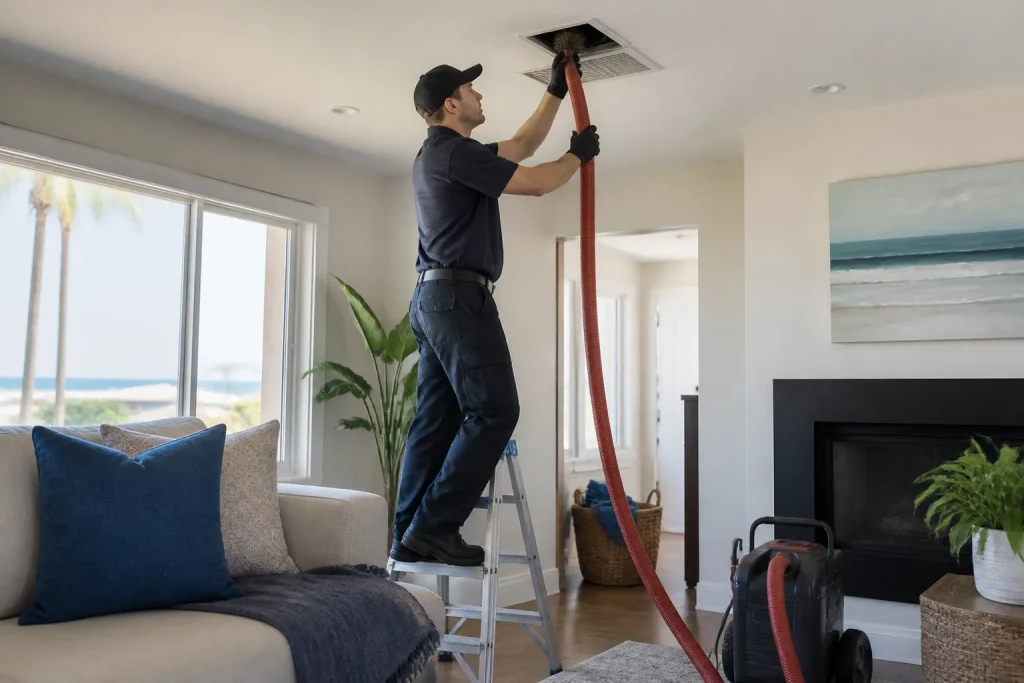
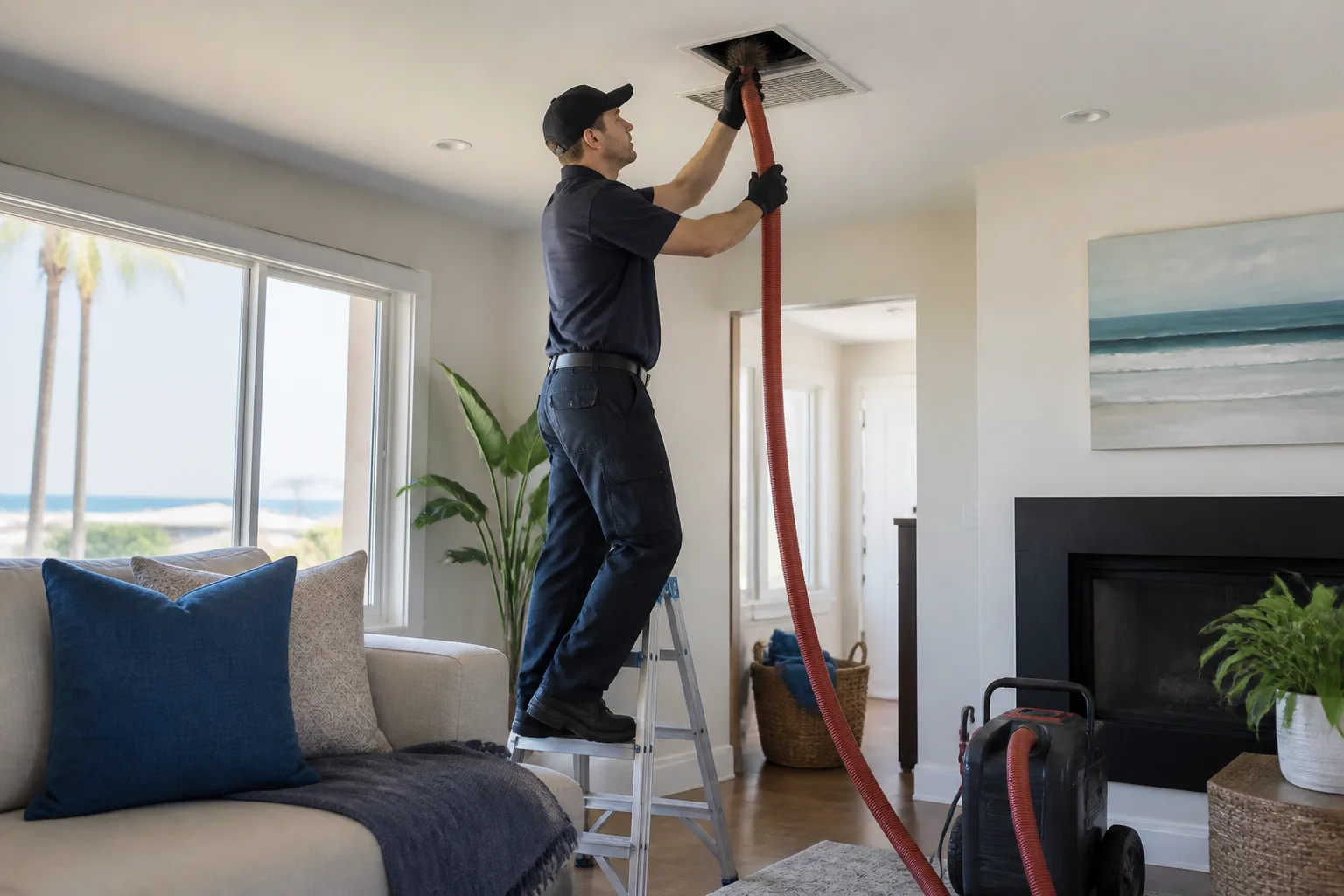
A contractor-grade negative-air machine for residential work should move at least 1,500 to 2,000 CFM. That’s the threshold where you get actual containment. Anything below that, and you’re paying someone to stir up dust, not remove it. We run Nikro HEPA negative-air machines on our air duct cleaning in Oceanside jobs specifically because they maintain proper containment while dislodged particulates are being pulled out. The HEPA rating matters too. It means the filter captures 99.97% of particles down to 0.3 microns, so what goes into the machine stays in the machine.
A modified shop vac might pull 150 to 300 CFM on a good day. It cleans the first few feet of duct near each register if you’re lucky. That’s not duct cleaning. That’s duct visiting.
The Equipment Verification Checklist: What Contractor-Grade Actually Looks Like
If you’re comparing duct cleaning companies in Oceanside, here’s what separates a real system from a portable toy. It’s not subtle once you know what you’re looking at.
What a contractor-grade system includes:
- Negative-air machine capable of 1,500 to 2,000 CFM minimum. This is the engine. If the company can’t state this number, they don’t have one worth stating.
- HEPA filtration on the negative-air unit. Not a standard bag filter. HEPA means the exhausted air is cleaner than the air in the room where the machine sits.
- Agitation equipment that physically contacts duct walls. Rotobrush contact-cleaning systems use rotating brushes that scrub the duct surface. Air-sweep-only methods blow air through the duct and leave compacted debris in place, especially in Oceanside where humidity has years to set that dust like concrete.
- Access tools for every component of the system. Return drops, supply trunks, branch runs, plenums, and the air handler all require different access points and tool lengths.
We use Rotobrush contact-cleaning technology on our jobs because air alone doesn’t remove the film that builds up inside ductwork. That film is a mix of dust, pet dander, skin cells, and moisture from Oceanside’s coastal climate. It sticks. It requires mechanical agitation to break it free before the negative-air machine can capture it. The two work together: brushes scrub, negative pressure removes. If a company only has one half of that equation, you’re getting half a cleaning.
How to Read NADCA Membership and ACR Certification Honestly
NADCA, the National Air Duct Cleaners Association, sets the standard for the industry. The ACR certification, or Air Systems Cleaning Specialist certification, is their professional credential. Both matter. Neither is sufficient on its own.
What NADCA membership verifies: the company has committed to following NADCA’s standards for cleaning procedures, which specify things like using source-removal methods and proper containment. The ACR certification verifies that at least one person at the company has passed an exam on duct cleaning principles, HVAC system components, and safety protocols.
What NADCA membership and ACR certification do not verify: the equipment the company actually brings to your house. You can pass a written test and still clean ducts with a Rotovac shoved into a Home Depot bucket. Certification tells you the crew knows how a proper cleaning should be done. It doesn’t tell you they have the machine to do it.
That’s why the equipment question comes first. Certification plus contractor-grade equipment is what you’re looking for in Oceanside. Certification without the CFM rating is just good intentions.
One more note on certifications: always verify a company’s claim. NADCA’s website has a directory. If a company says they’re certified, check. It takes thirty seconds and it’s the difference between verification and a vinyl sticker on a van.
The Four Questions to Ask Before Booking Any Duct Cleaning in Oceanside
Write these down. Ask them in order. The answers will tell you everything you need to know in under five minutes.
Question 1: What negative-air machine do you use, and what’s its CFM rating?
We covered this above. If they can’t answer, end the call. A company that doesn’t know its equipment specs is a company that doesn’t understand the job.
Question 2: Do you use contact cleaning or air-sweep only?
Contact cleaning means brushes or agitation tools physically scrub the duct walls. Air-sweep means high-pressure air is blown through the system. Air-sweep alone doesn’t remove adhered debris. In Oceanside, where salt air and humidity interact with household dust, adhered debris is the whole problem. Ask directly: “Do your tools touch the duct walls?” If the answer is anything but yes, move on.
Question 3: If you find damaged or disconnected ductwork, do you repair it?
Most duct cleaners in Oceanside will clean around problems. They’ll note it on the invoice with a recommendation to call an HVAC contractor. Then you have to schedule a second appointment, get a second quote, and wait another two weeks. Recommend asking whether the company handles air duct repair in Oceanside in-house. It’s a genuine indicator of capability. A crew that can repair what it finds is a crew that actually looks for problems. A crew that can’t has every incentive to pretend the disconnected return they just cleaned around doesn’t exist.
Question 4: Will you provide before-and-after photos of my actual ductwork?
This is non-negotiable. A legitimate duct cleaning produces visual proof. The photos should be taken inside your ducts, not pictures of the equipment sitting in your driveway. We photograph every job at multiple points: before cleaning, after cleaning, at each return, each supply register, and inside the plenums. If a company hesitates on this question, assume they have a reason. The reason is usually that their results don’t look good on camera.
Red Flags Specific to the Oceanside Market
Oceanside has its own particular set of problems when it comes to duct cleaning. We’ve been doing this work here long enough to see the patterns repeat.
Per-vent pricing
Some companies quote a price per vent or per register. That creates a bad incentive: the faster they count vents, the faster they leave. Per-vent pricing discourages the slow, methodical work that actual duct cleaning requires. It also leads to absurd math where a 2,000 square foot house in Rancho del Oro gets quoted at $99 for “up to 10 vents” and another $15 per vent after that. The math never works out to an honest price for honest work. Look for a company that prices the whole system, not the vent count.
Quotes given without a home inspection
A duct system’s price depends on access, layout, the condition of the ducts, the type of air handler, and whether there’s been construction or remodeling. No legitimate company can quote accurately over the phone without seeing the system. If someone gives you a firm price before looking at anything, they’re either going to change it when they arrive or they’re going to skip the parts of the job that make the price unprofitable. Either way, you lose.
Subcontracting to uncredentialed crews
Some Oceanside companies sell the job and then hand it to an independent crew with whatever equipment that crew happens to own. You don’t know who’s showing up, what machine they’re bringing, or whether they’ve been trained to NADCA standards. Ask who will actually be doing the work. If it’s not the company’s own employees with the company’s own equipment, keep looking.
The coupon mailer problem
Those oversized postcards that show up in Oceanside mailboxes every spring advertise duct cleaning for prices that don’t pay for the fuel to drive to your house. They’re loss leaders designed to get a crew in the door, at which point the upsell begins. Filters, sanitizers, antimicrobial foggers, UV lights. The cleaning was never the product. You were.
What a Legitimate Post-Service Report Should Include
The work isn’t finished when the hoses go back on the truck. A real duct cleaning company leaves behind documentation. Here’s what to expect.
- Before-and-after photos of your ducts. Not stock photos. Not photos of the equipment. Actual images from inside your system, taken the same day. If the company offers video, even better.
- An itemized list of components serviced. This means the return side, the supply side, the main trunk line, each branch run, the plenums, and the air handler. If the list just says “all ducts,” ask for specifics.
- Deficiencies found during cleaning. Disconnected joints, crushed flex ducts, mold growth, pest intrusion, collapsed sections. A real cleaning surfaces these problems. A fake one hides them.
- Recommended follow-up. This might be a repair item, a filter recommendation, or a suggestion to run the system differently. It should be specific and tied to what was observed during the job.
The absence of a post-service report is a reliable signal that the job wasn’t done properly. We’ve walked into homes in Oceanside where the previous “cleaning” produced nothing but a receipt. No photos, no report, no evidence of work beyond a lingering smell of lemon-scented spray. If there’s no documentation, there’s no way to know what happened inside your ducts. And that’s exactly how the bad operators prefer it.
One more thing on reports: the photos should be date-stamped and include enough visual context to actually identify each location. A dark blurry rectangle tells you nothing. You should be able to see the register, the duct wall, and the condition before and after.
When to Call a Pro Instead of Screening One
If your ducts haven’t been cleaned in five years or more, if you’ve just finished a remodel, or if you’re noticing dust reappearing within days of cleaning your home, skip the search and get an assessment. The screening advice above assumes you have time to make calls and compare. Sometimes you just need someone who already has the equipment, the documentation standards, and the repair capability in place.
Duct cleaning in Oceanside is what our team does with Rotobrush contact-cleaning systems and Nikro HEPA negative-air machines. We also handle dryer vent cleaning in Oceanside, which matters more than most people realize: lint-clogged dryer vents are a documented fire risk, and Oceanside’s older homes often have long vent runs that accumulate lint faster than newer construction. If you have a Honeywell, Aprilaire, or Guardsman filtration system, we work around and with those units rather than cleaning past them and hoping for the best.
The Bottom Line
Choosing the right duct cleaning company in Oceanside comes down to equipment verification first, certification second, and price a distant third. Ask about CFM. Ask about contact cleaning. Ask about repair capability and documentation. A company that can answer all four questions confidently is a company that’s done the work before and can prove it. A company that can’t answer the CFM question is betting you won’t ask it.
If you’re in Oceanside and want an honest assessment without the coupon games, Duct Cleaning Oceanside offers free estimates. Call (855) 382-4811 and ask us about our equipment first. We’ll answer before you finish the question.
Frequently Asked Questions
In Oceanside, a legitimate whole-system air duct cleaning typically ranges from $450 to $900 for an average single-family home, depending on system size, access, and the condition of the ductwork. The correct answer to this question is a lot more useful than a coupon price. A whole-system range reflects the reality that your duct layout and level of contamination determine the labor involved. Be wary of quotes below about $300, as they almost always involve per-vent pricing games, air-sweep-only methods, or upsells for things that should be included. We price one flat rate per system agreed before work starts, so the quote you get is the price you pay. Call (855) 382-4811 for an exact quote on your Oceanside home, estimates are free.
The cheap quotes come from companies using portable equipment that can’t create proper negative pressure, using air-sweep-only methods that don’t remove adhered debris, or pricing per vent so they can leave as soon as the counting is done. In Oceanside’s humid coastal climate, adhered debris is the primary problem, and removing it requires contact-cleaning equipment and contractor-grade negative-air machines. Those machines cost money, and the crews who know how to use them cost money too. A low quote usually means the work is being skipped, not that you found a bargain. Get an itemized explanation of what’s included before you book. Call (855) 382-4811 to talk through what a full-system cleaning actually involves, estimates are free.
You should receive before-and-after photos of your actual ductwork, taken inside the system on the day of cleaning. The photos should show identifiable locations: each return, supply register, the trunk line, and the plenums. You should also receive an itemized list of components serviced and a deficiency report covering anything the crew found during cleaning, from disconnected joints to crushed flex ducts. If a company can’t produce visual documentation of the work, assume the work didn’t happen. That’s the standard we hold ourselves to on every Oceanside job. Call (855) 382-4811 if you’d like to see examples of what a real post-service report looks like.
For most Oceanside homes, every three to five years is a reasonable interval, with a few caveats. Homes with pets, recent remodels, or residents with allergies may need cleaning more often, as coastal humidity binds dust faster here than in drier inland climates. If you’ve just bought a home and can’t verify when the ducts were last cleaned, do it once for the baseline. After that, the best indicator is visual: pull a return grille and look inside. If you see dust accumulation on the duct walls rather than bare metal, it’s time. Call (855) 382-4811 and we’ll help you assess whether your system is due, estimates are free.
Written by the team at Duct Cleaning Oceanside, serving Oceanside since 2011.
Need Air Duct Cleaning Help?
Call Duct Cleaning Oceanside - licensed & insured, with free written estimates in Oceanside.
(855) 382-4811